
How to Spot Faulty Wiring Behind Your Walls
Most homeowners never see the wiring that runs through their walls, and that hidden location is exactly what makes damaged conductors so dangerous. Late August in the Lehigh Valley puts heavy stress on a home electrical system, because central air, dehumidifiers, and window units all pull current for hours at a stretch. Weak connections that stayed quiet through the mild spring months begin to heat up under that sustained load, and the first symptoms usually arrive as small annoyances rather than dramatic failures. A light that flickers when the compressor starts, a receptacle that feels warm under your hand, or a breaker that trips on humid afternoons all deserve real attention instead of a shrug. Fires that begin inside a wall cavity can smolder for several minutes before smoke ever reaches a detector, which is why catching the early signals matters so much. This guide walks through the symptoms that point toward damaged conductors, the methods a licensed electrician uses to confirm the problem, and the repairs that bring a circuit back to a safe and code compliant condition. By the end, you should have a clear sense of what warrants an immediate phone call and what can reasonably wait for a scheduled service visit.
Warning Signs of Faulty Wiring Behind Your Walls
Damaged conductors send signals long before they cause a fire, though those signals are easy to dismiss as the quirks of an older house. Pattern matters far more than any single event, so a light that flickers once during a thunderstorm means something very different from a light that flickers every time the microwave runs. Keep a short written record of what happens, where it happens, and what else is running at that moment, because that record helps an electrician narrow down the affected circuit in minutes rather than hours. Symptoms almost always cluster in one part of the home or on one branch circuit, and that clustering points toward a specific junction box, splice, or run of cable inside the wall. Some warning signs involve what you see, others involve what you smell, hear, or feel through your fingertips, and the most serious situations involve all three at the same time. The sections below sort those signals into groups so you can match what your home is doing to the underlying cause.
Lights and Outlets That Signal Faulty Wiring Behind Your Walls
Lighting problems are usually the first symptom a family notices, and they are also the easiest to misread. A single bulb that flickers points to a loose lamp holder or a failing bulb, but an entire room that dims when the refrigerator or air conditioner starts up suggests a loose connection somewhere upstream on that circuit. When lights across two different rooms brighten and dim in opposition to each other, that behavior often indicates a compromised neutral connection at the panel or in the service equipment, and it can drive voltage well above 120 volts on part of the system. High voltage on a circuit destroys electronics quickly and quietly, so appliances and computer power supplies that fail in clusters are worth mentioning to your electrician. Flickering that follows a specific appliance around the house tells a different story than flickering that shows up on one circuit only. Recessed fixtures that shut off on their own and restart a few minutes later are usually tripping an internal thermal protector, which sometimes traces back to overheating conductors in the ceiling cavity above. Take note of the time of day and the weather, since heat and humidity both influence how a marginal connection behaves.
Receptacles tell an equally clear story once you know what to look for. Discoloration around the slots, a brownish halo on the cover plate, or any melting on the plastic face means heat has been building at the terminations behind that device. Plugs that fall out under their own weight indicate worn contacts, and a loose grip on the blades of a plug generates resistance, which in turn generates heat inside a closed box. Outlets that work intermittently, or that go dead and come back when you jiggle a cord, frequently trace back to push in terminations on the back of the device rather than screw terminals, and those push in connections loosen over the years as the metal expands and contracts. A receptacle that stops working entirely without tripping a breaker is a strong indicator of a failed splice in a box somewhere along the run. In many older Lehigh Valley homes, several outlets on the same wall will fail together because they share a single upstream connection that has come apart. Never assume a dead outlet is simply worn out, because the cause usually sits farther back in the circuit.
Switches and dimmers round out the visual clues. A faceplate that feels warm after the lights have been off for an hour is not normal, and neither is a switch that has to be nudged into position before the light responds. Standard dimmers do run slightly warm during operation because they dissipate energy as heat, but a dimmer hot enough to be uncomfortable to touch has either been loaded beyond its rating or is sitting on compromised conductors. Blackened screw terminals visible when the plate comes off confirm that arcing has already occurred inside the box. Older three way switch circuits that behave unpredictably often hide damaged travelers inside the wall, especially in homes where a remodel added or moved fixtures without proper boxes. Anything that scorches, warms, or hesitates should be turned off at the breaker until it can be inspected properly. Seeing any of these signs in your home? Click here for our electrical wiring services.
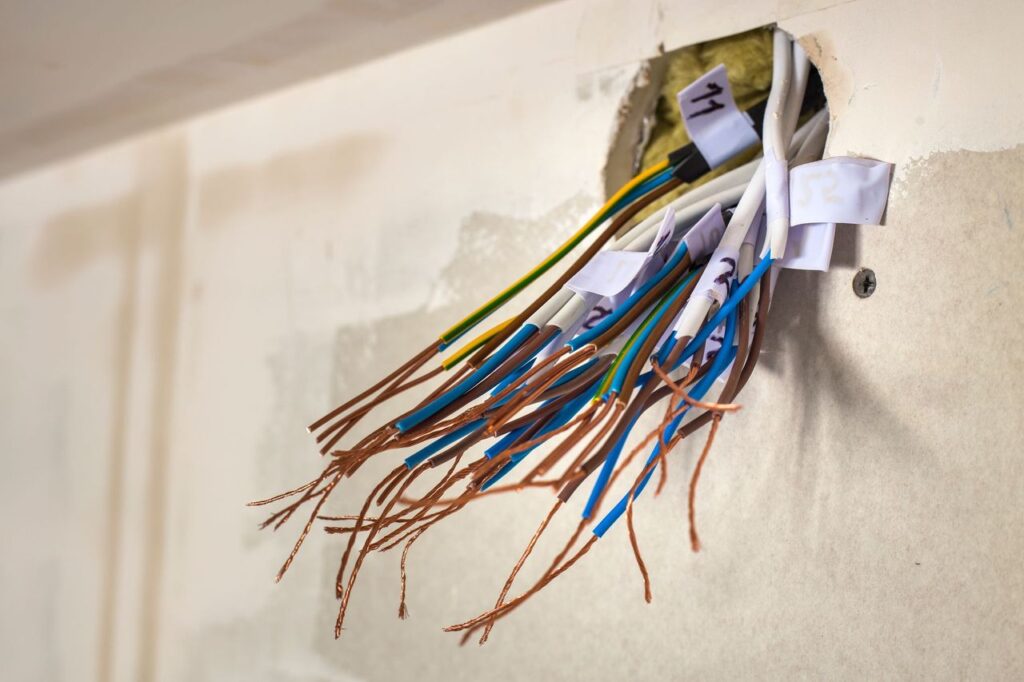
Smells, Sounds, and Heat That Point to Faulty Wiring Behind Your Walls
Odor is the single most urgent warning your electrical system can give you. Overheated conductor insulation gives off a sharp smell that people commonly describe as burning plastic, and in some cases the chemistry of heated wire coatings produces a distinct fishy odor with no food source anywhere nearby. That smell means insulation has already reached a temperature high enough to break down, and breakdown of insulation is the last barrier between an energized conductor and the wood framing around it. If you notice that odor near a receptacle, a switch, or the panel itself, turn off the circuit at the breaker and keep it off. Do not spray anything on the area, do not open the wall, and do not plug anything else into nearby outlets on the same circuit. A faint ozone smell, similar to the air after a lightning strike, also indicates active arcing somewhere in the system. Trust your nose here, because the smell usually arrives before any visible damage appears on the surface of the wall.
Sound gives you the second layer of evidence. Healthy branch circuit wiring is silent, so a sizzling, crackling, or frying noise coming from inside a wall or from behind a cover plate means current is jumping across a gap instead of flowing through a solid connection. A steady hum at the panel can come from a breaker that has lost its clamping force on the bus bar, and that loss of contact pressure creates heat at the exact point where the breaker seats. Buzzing that grows louder as more load comes on the circuit follows the same principle, since resistance rises with current and heat rises with resistance. Popping sounds when a switch is operated point to arcing across worn contacts, either at the device or at a splice farther down the run. Rodent activity in exterior walls sometimes produces both scratching sounds and chewed insulation on the cable itself, which is a common cause of hidden faults in older Pennsylvania homes with fieldstone foundations. Any noise from the electrical system deserves an evaluation rather than a wait and see approach.
Heat is the third signal, and it is the one most people can check safely in a few minutes. Walk the house and rest the back of your hand briefly against each cover plate on the circuits that concern you, since a plate that is noticeably warmer than the surrounding wall is telling you that energy is being wasted as heat inside the box. Warm spots on drywall away from any device sometimes indicate a splice buried in the wall without a box, which is both a code violation and a genuine fire risk. An inexpensive infrared thermometer makes this check more precise, though a professional thermal camera gives a far more complete picture across the panel and the accessible portions of each run. Pay particular attention to circuits feeding window air conditioners, since a 15 amp circuit running near its limit for hours will expose any weak termination on that run. Heat that appears only during heavy summer load still counts as a real problem, and it will not fix itself when the weather cools. Smelling burning plastic or hearing arcing right now? Click here for our emergency electrician service.
Breaker Trips and Shocks Caused by Faulty Wiring Behind Your Walls
A breaker that trips is doing exactly what it was designed to do, and treating it as a nuisance is one of the most common and most dangerous mistakes homeowners make. The circumstances of the trip tell an electrician a great deal about the underlying cause. A breaker that trips only when several appliances run together is usually responding to an overload, which is a load management issue and often solved by adding a dedicated circuit. A breaker that trips instantly the moment you reset it points to a short circuit or a ground fault somewhere in the wiring, and that fault will not clear on its own. Trips that happen on humid days, during heavy rain, or shortly after a storm often trace to moisture reaching a compromised splice or an exterior box that has lost its seal. Never replace a tripping breaker with one of a higher amperage rating, because the breaker is sized to protect the conductor and a larger breaker simply allows the wire to overheat before anything shuts off.
Arc fault and ground fault protection devices add another layer of information. An arc fault circuit interrupter monitors the current waveform for the signature of arcing and shuts the circuit down when it detects that pattern, which is why the current adopted edition of the National Electrical Code requires that protection across most living areas of a home. Repeated arc fault trips on a single circuit frequently indicate a damaged conductor, a loose termination, or a screw driven through a cable during a past remodeling project. Ground fault circuit interrupters watch for current leaving the circuit through an unintended path, so a GFCI that trips repeatedly in a bathroom, kitchen, garage, or outdoor location may be detecting moisture intrusion or damaged insulation. Swapping either device for a standard breaker to stop the tripping removes the protection while leaving the fault fully intact. Reset the device once, and call an electrician if it trips again. These devices frequently catch problems months before a homeowner would notice any other symptom.
Physical sensation is the final category, and it demands immediate action. A tingle when you touch an appliance, a metal cover plate, a faucet, or a laundry machine indicates that voltage is present on a surface that should be at zero potential. That condition typically comes from a missing or broken equipment grounding conductor, a damaged appliance cord, or a neutral connection that has failed somewhere on the system. Older homes with two prong receptacles have no equipment grounding conductor at all, which means a fault inside an appliance has no low resistance path back to the panel and can energize the appliance housing instead. Even a mild shock signals a fault serious enough to injure someone with a heart condition or someone standing on a wet basement floor. Shut off the circuit and schedule service the same day, because there is no safe version of a home that shocks the people living in it.
How Electricians Confirm Faulty Wiring Behind Your Walls
Finding a hidden fault is a process of elimination that moves from the panel outward, and a good electrician works that process in a specific order to avoid unnecessary demolition. The goal is always to locate the exact box, splice, or damaged section of cable so the repair stays contained rather than turning into a full rewire of the house. Diagnosis begins with the information you provide, moves to visual examination of everything accessible, and then relies on instruments to measure what the eye cannot see. Accessible areas such as the basement, the attic, the garage, and the panel itself usually reveal the root cause, since most faults live at connection points and most connection points sit inside boxes. Only after those steps come up empty does the work move to opening small sections of drywall in targeted locations. The methods below explain how a licensed electrician builds that picture safely.
The Visual Inspection That Starts Every Faulty Wiring Diagnosis Behind Your Walls
The panel is the first stop on any wiring investigation, because it aggregates every circuit in the home into one enclosure. With the cover removed and proper protective equipment in place, an electrician looks for conductors discolored by heat, terminations that have loosened, breakers not properly seated on the bus, and neutrals or grounds doubled under a single lug where the terminal is listed for one wire only. Double tapped breakers, meaning two conductors landed on a terminal designed for one, are extremely common in homes that have been added onto over the decades and are a frequent source of intermittent faults. Breakers from a different manufacturer than the panel are another red flag, since only tested and listed combinations are permitted and mismatched breakers may not clamp the bus correctly. The main bonding jumper, the grounding electrode conductor, and the condition of the neutral bar all get checked, because problems at any of those points create symptoms throughout the entire house. Corrosion inside the enclosure suggests water entry from the service mast or a wall penetration. Panel findings frequently explain symptoms that seemed random when viewed room by room.
Attics, basements, crawl spaces, and garages come next, since those areas expose actual cable runs without any demolition. An electrician looks for junction boxes with missing covers, splices made outside of a box, cable stapled so tightly that the sheathing is crushed, and cable run across framing without the protection required where it passes near the face of a stud. Nail plates missing from drilled studs are a strong clue in any home that has been remodeled, because a single fastener driven into a cable during a past project can create a fault that appears years later. Rodent damage shows up as stripped sheathing and exposed copper, most often near rim joists and around insulation. In the older housing stock around Whitehall, Allentown, and Bethlehem, it is common to find several generations of wiring spliced together with methods that were acceptable at one time but no longer meet code. Cable that has been buried in blown insulation or covered by later construction gets special attention, since heat has nowhere to go in those conditions. Documenting every one of these findings gives the homeowner a complete picture instead of a single patch.
Individual devices are the third layer of visual inspection. With the circuit de energized and verified dead, an electrician removes receptacles and switches to examine the terminations directly, since scorching, melted insulation, and copper darkened by heat only become visible once the device is pulled from the box. Push in style back wire connections get replaced with connections made on the screw terminals, which provide far more contact area and hold their clamping pressure over time. Box fill is checked as well, because too many conductors crowded into a small box traps heat and stresses the splices every time a device is pushed back into place. Aluminum conductors, if present, are noted immediately and handled with listed repair methods rather than standard wire connectors. Any splice found outside a box is corrected, and any box without a cover receives one. Want a complete evaluation of your home wiring before something fails? Click here for our electrical inspection service.
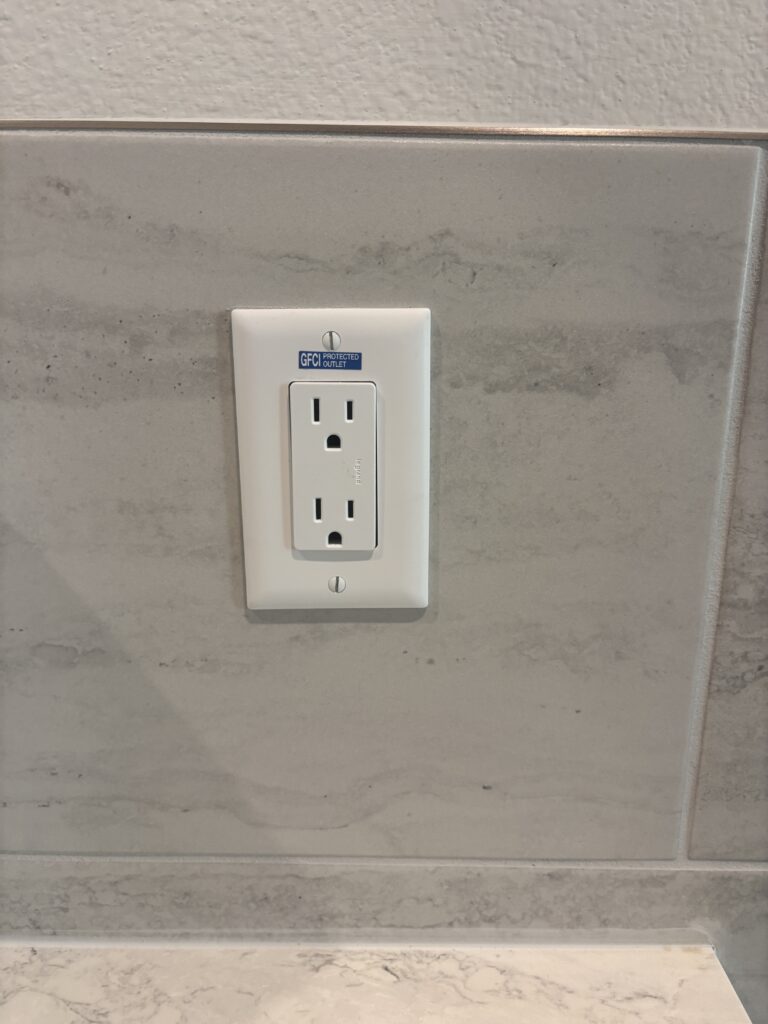
Testing Tools That Locate Faulty Wiring Behind Your Walls
Instruments turn suspicion into confirmation. A non contact voltage tester provides a quick indication of energized conductors and is used constantly for safety, though it never substitutes for a meter reading when verifying that a circuit is truly dead. A digital multimeter measures voltage under load, which is where hidden problems reveal themselves, since a receptacle may read a healthy 120 volts with nothing plugged in and drop dramatically once a heater or a load bank is applied. Excessive voltage drop under load is one of the most reliable indicators of a loose or corroded connection somewhere upstream, and the code recognizes roughly three percent drop on a branch circuit as a reasonable design target. A clamp meter measures actual current draw without breaking the circuit, which helps separate a genuine overload from a wiring fault. Plug in outlet testers are useful for a fast check of basic wiring configuration, though they cannot detect a bootleg ground, a reversed polarity condition on a two wire system, or a marginal connection that only fails under load. Professional diagnosis pairs those readings with the symptom history the homeowner provided.
Locating the fault physically requires a different set of tools. A circuit tracer sends a signal onto the conductor and a receiver follows that signal through the wall, allowing an electrician to map a run and pinpoint where it terminates or where it breaks. Thermal imaging cameras reveal heat signatures at the panel, at devices, and sometimes through drywall, which makes them extremely effective at finding overheating terminations before any damage becomes visible. An insulation resistance tester, used only on a fully de energized and disconnected circuit, applies a test voltage to measure how well the insulation is holding, and low readings confirm degraded or damaged cable that visual inspection would miss entirely. Borescopes let an electrician look inside a wall cavity through a very small opening, which keeps repairs contained. Each of these tools narrows the search area, and narrowing the search area is what keeps drywall repair to a minimum. The combination of measurement and location work is what separates a professional diagnosis from guesswork.
Interpretation is where experience carries the most weight. A single reading rarely tells the whole story, so an electrician compares results across multiple points on the same circuit and against similar circuits elsewhere in the home. Readings taken during heavy load conditions often differ from readings taken on a quiet system, which is why testing sometimes happens while the air conditioning runs. Environmental factors including humidity, temperature in the attic, and recent storm activity all get weighed against the symptom timeline. When the evidence points to widespread degradation instead of one bad connection, the honest recommendation may be partial or full replacement of the affected runs rather than repeated repairs. Homeowners deserve to hear that assessment clearly, along with the reasoning behind it and the options available at different price points. Good diagnosis produces a plan, not just a verdict.
Older Home Wiring Types That Turn Into Faulty Wiring Behind Your Walls
Knob and tube wiring appears in many homes built before 1950 throughout the Lehigh Valley, and it was competent work for its era. It uses separate conductors for the ungrounded and grounded legs, supported by ceramic knobs and passing through ceramic tubes at framing members, with air space around the wire providing much of the cooling. That air space is the problem today, because generations of homeowners have added blown insulation into those same cavities, and code prohibits burying this type of wiring in thermal insulation for exactly that reason. The rubber and cloth insulation on the conductors also becomes brittle after decades of heat cycling, cracking away from the copper wherever it is disturbed. Knob and tube circuits provide no equipment grounding conductor, which means modern three prong appliances have no fault path back to the panel. Splices made into this system by previous owners are a frequent source of arcing and hidden heat.
Aluminum branch circuit wiring, installed widely in homes built roughly between 1965 and 1973, presents a different set of issues. Aluminum expands and contracts more than copper as it heats and cools, and that movement gradually loosens terminations at devices and splices unless the connection is made with methods rated for the material. Loose terminations increase resistance, resistance produces heat, and heat accelerates the cycle until the connection fails or ignites nearby material. Approved remediation methods include listed connectors designed for the transition between aluminum and copper, along with proper application of antioxidant compound where required by the product listing. Receptacles and switches on these circuits must carry the correct rating for aluminum conductors rather than standard devices. Homes with aluminum branch circuits are entirely safe to live in once remediated properly, but ignoring the material is not a reasonable option.
Early cloth sheathed nonmetallic cable and ungrounded two wire systems fill out the list. The fabric outer sheathing on mid century cable degrades and flakes off, and the rubber insulation underneath hardens until it cracks at every bend and termination. Many of these homes still operate on a 60 amp service that was sized for a refrigerator, a few lights, and a radio, which leaves nothing for central air, an electric range, or an EV charger. Adding modern loads to undersized and aged infrastructure is exactly how hidden faults get pushed past their limit during a hot August week. When the wiring, the panel, and the service all date to the same era, upgrading them together usually costs less and delivers far better results than a series of isolated repairs. Living in an older Lehigh Valley home with dated wiring? Click here for our electrical service upgrade options.
Why You Need a Licensed Electrician for Faulty Wiring Behind Your Walls
Hidden wiring faults are not a reasonable do it yourself project, and the reasons go well beyond the obvious shock hazard. Working inside energized enclosures requires training, testing equipment, and protective gear, and correcting a fault requires knowing which repair methods are actually listed for the materials involved. A repair that looks finished but violates code creates liability during a future home sale and can complicate an insurance claim after a loss. Licensed work also carries permits and inspection where required, which gives you documented proof that the wiring in your home meets the standard. Getting this right protects your family, your property, and the value of the house itself.
The Safety Payoff of Repairing Faulty Wiring Behind Your Walls
Electrical failures remain a leading cause of residential structure fires, and the majority of those failures start at connection points rather than in the middle of an undisturbed run. Repairing a loose termination or replacing a damaged section of cable removes the ignition source entirely instead of managing around it. That single repair also stops the slow damage that voltage fluctuation causes to appliances, electronics, and LED drivers throughout the home. Families sleep better knowing the flickering and the burning smell are gone for a documented reason rather than because the symptom happened to quiet down. Peace of mind has real value when the alternative is wondering what is happening inside the walls at two in the morning.
Correcting hidden faults also improves how the whole system performs day to day. Solid connections deliver full voltage to each device, which means motors start cleanly, lights hold steady, and sensitive electronics receive the clean power they were designed to use. Circuits stop tripping without warning, which matters enormously for a chest freezer in the basement or a sump pump during a summer downpour. Adding proper grounding where it was missing restores the fault path that modern appliances depend on for protection. Many homeowners notice the difference immediately in rooms that always seemed to have unreliable outlets.
Documentation is the third benefit and the one most often overlooked. A written record of the diagnosis, the repair, and any permits pulled becomes a genuine asset during a real estate transaction, because buyers and their inspectors ask hard questions about older homes. Insurance carriers frequently want confirmation that knob and tube or aluminum branch wiring has been remediated by a licensed contractor before they will write or renew a policy. Having that paperwork on hand turns a potential deal breaker into a simple answer. It also gives the next electrician who works on your home a clear map of what has already been addressed.

What Repair Work for Faulty Wiring Behind Your Walls Involves
Most repairs are far less invasive than homeowners expect, since accurate diagnosis usually narrows the work to one or two specific locations. A failed splice inside an accessible junction box may take under an hour to correct, including replacing damaged conductor ends and installing a proper cover. Faults inside a finished wall require a small opening at the identified location, and experienced electricians cut those openings cleanly to keep patching straightforward. Cable that has been damaged by a fastener or by rodents gets replaced from box to box rather than spliced blindly inside the cavity. Every repair ends with testing to confirm the circuit performs correctly under actual load.
Larger projects follow a staged plan built around how the household actually functions. Rewiring one circuit at a time lets a family stay in the home with power to essential areas while work progresses, and it spreads the investment over a schedule that fits the budget. Fishing new cable through existing walls is a skilled process that uses attic space, basement ceilings, closets, and existing chases to minimize openings in finished surfaces. Adding arc fault and ground fault protection during the work brings the circuits up to current requirements and adds a monitoring layer that catches future problems early. Clear communication about what happens each day keeps the project predictable from start to finish.
Cost transparency matters just as much as the technical work. A reputable electrician explains what was found, shows the evidence, and presents options ranging from a targeted repair to a comprehensive upgrade with honest tradeoffs for each. Financing helps many families address serious wiring issues on the right timeline instead of postponing work that should not wait. Written pricing before the work begins means no surprises when the invoice arrives. Ready to get a wiring problem repaired the right way? Click here for our electrical repair service.
Why Choose Edinson Electrical Solutions for Faulty Wiring Behind Your Walls
Edinson Electrical Solutions is a family owned and operated local business serving Hokendauqua, Whitehall, Allentown, Bethlehem, Easton, Emmaus, Nazareth, and the surrounding Lehigh Valley communities. We are licensed and insured in the State of Pennsylvania, and every job we perform is built to be code compliant and reliable for the long haul. Our team treats hidden wiring faults as the safety issue they are, which means we diagnose thoroughly rather than guessing at the cheapest possible patch. We show you what we found and explain the reasoning behind every recommendation in plain language. Knowing the local housing stock helps us move quickly, because we work in these homes every week.
Every job we complete carries our lifetime craftsmanship warranty, which reflects how seriously we take the quality of our own work. Financing is available through Synchrony for homeowners facing a larger repair or a full rewire, so a serious safety issue does not have to wait for the right month. We are dedicated to providing a 5 star service on every call, from the first phone conversation through the final walkthrough and cleanup. Respect for your home and your schedule is part of the job, not an extra. That standard applies equally to a single receptacle and to a whole house rewire.
If your lights flicker, your outlets run warm, or you have smelled anything burning near a wall or a panel, reach out today and let us take a look. Call Edinson Electrical Solutions at (484) 898-7788 or email info@edinsonelectrical.com to schedule an evaluation. Our office is located at 3049 Birch St, Hokendauqua, PA 18052, and we serve homeowners throughout the Lehigh Valley. Hidden wiring problems only get worse with time, load, and heat. Let our licensed team find the fault, fix it properly, and give you back the confidence that your walls are safe.