
The Real Reason Your Breaker Keeps Tripping When You Run a Space Heater
Cool mornings arrive in the Lehigh Valley long before anyone wants to run the furnace full time, and that is usually when the space heaters come out of the closet. The problem is that a portable heater is one of the largest single loads most people ever plug into a standard wall outlet, and your electrical system does not always have room for it. If your breaker keeps tripping every time the heater runs for ten or fifteen minutes, that breaker is not broken and it is not being dramatic. It is doing exactly the job it was installed to do, which is to shut off power before the wire inside your wall gets hot enough to damage its insulation. The real reason behind the trip is almost always one of three things: the circuit is carrying more current than it was designed to carry, the heater is sharing that circuit with loads you forgot about, or there is a weak connection somewhere in the run that is turning electrical energy into heat. Understanding which of those three is happening in your home matters, because two of them are inconvenient and one of them is a fire risk. Below is a plain explanation of what is actually going on inside the wall, how to tell the difference, and when the situation calls for a licensed electrician instead of another trip to the hardware store.
Why Your Breaker Keeps Tripping When You Run a Space Heater
Almost every portable electric heater sold in the United States tops out at 1500 watts on its high setting, and that number is not an accident. At 120 volts, 1500 watts pulls roughly 12.5 amps of current, which sits right at the practical ceiling of a standard 15 amp household circuit. Electrical code treats any load that runs for three hours or more as a continuous load, and continuous loads are limited to 80 percent of a circuit’s rating for good reason. That means a 15 amp circuit is only rated for 12 amps of continuous draw, and a heater running all evening quietly exceeds that limit before you plug in anything else at all. Your breaker responds with a thermal trip, which is a slow, deliberate shutoff that happens after several minutes of sustained overload rather than the instant you flip the switch. Homeowners often misread that delay as a random failure, when in fact the delay is the clearest clue available about what went wrong. The sections that follow break down the three most common causes we find in Whitehall, Bethlehem, Allentown, and the surrounding towns when a space heater keeps knocking out a breaker.
The Space Heater Amp Draw That Makes Your Breaker Keep Tripping
Start with the math, because the math explains most of these calls before we ever open a panel. A 1500 watt heater divided by 120 volts equals 12.5 amps of continuous current, and that current flows the entire time the heating element is energized. Circuits in older Lehigh Valley homes are frequently 15 amp circuits wired with 14 AWG copper conductors, which gives you a real world continuous budget of 12 amps. The heater alone overshoots that budget by half an amp, and half an amp does not sound like much until you remember that the breaker is measuring heat buildup over time rather than instantaneous current. Voltage in a home also sags under load, and when supply voltage drops toward 115 volts, the same heater draws closer to 13 amps to deliver the same output. Add a floor lamp, a phone charger, and a television on that same circuit and you are comfortably past the breaker’s tolerance. The trip is not a defect; it is a correctly sized safety device performing its function.
Many people try to solve this by turning the heater to its low setting, and that does help, though not always as much as expected. Low settings on most portable heaters run around 750 to 900 watts, which cuts the draw to somewhere between 6 and 7.5 amps and leaves real headroom on a 15 amp circuit. The catch is that a lower setting also produces less heat, so the heater runs longer and cycles less, and people often bump it back up once the room fails to warm. Oil filled radiator style heaters have the same wattage ceiling, so they draw identical current even though they feel gentler. Fan forced ceramic units add a small motor load on top of the element, and that motor pulls a brief inrush current every time the fan starts. None of these designs will fit comfortably on a circuit that is already busy. The wattage rating printed on the heater’s label is the number that matters, and it is worth reading before you decide the breaker is at fault.
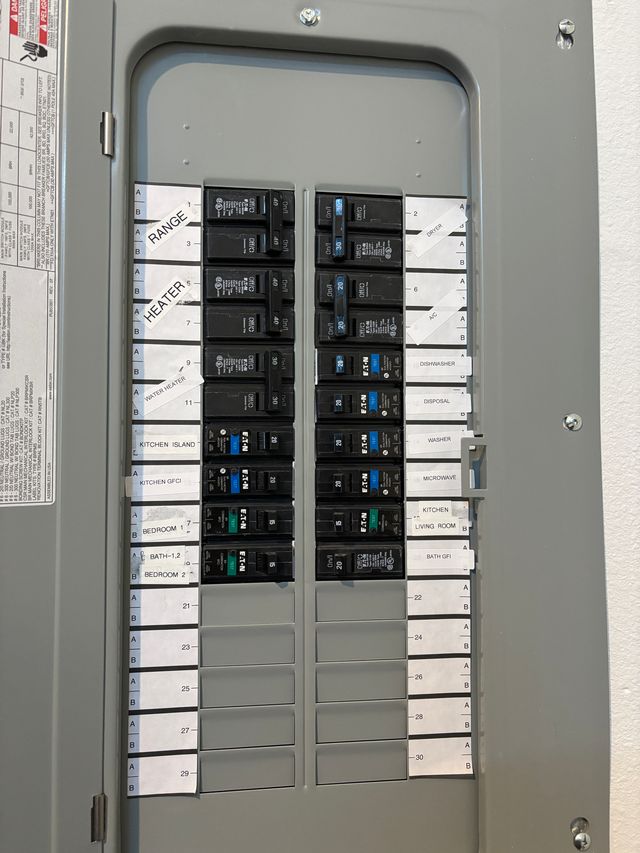
A 20 amp circuit changes the picture, though not as completely as most homeowners assume. Twenty amp circuits are wired with 12 AWG copper and carry a continuous budget of 16 amps, which leaves a 1500 watt heater about 3.5 amps of breathing room. That margin is enough for lighting and small electronics, and it is not enough for a second heater, a window air conditioner, a microwave, or a hair dryer. Kitchens, garages, and bathrooms often have 20 amp circuits, while bedrooms and living rooms in older houses usually do not. Homeowners sometimes assume a bedroom outlet is on a 20 amp circuit because the receptacle looks new, but receptacle appearance tells you nothing about the breaker feeding it. The only reliable way to know your circuit rating is to read the number stamped on the breaker handle inside the panel. If that number is 15 and you are running a 1500 watt heater for hours, you have found your answer.
Shared Circuits and the Space Heater Breaker Tripping Problem
Residential circuits in most homes serve far more outlets than people realize, and that is the second major reason a space heater keeps tripping a breaker. A single 15 amp bedroom circuit commonly feeds every receptacle and ceiling light in two or three rooms, plus a hallway light and sometimes a closet fixture. Builders wire it that way because code allows it and because it keeps material costs down, not because those rooms have low demand. You plug a heater into the bedroom, someone else turns on a bathroom light and a television down the hall, and the total load quietly climbs past the breaker’s rating. The trip appears random because the additional loads change from hour to hour and nobody is tracking them. This is why a heater can run fine for two nights and trip the breaker on the third.
Mapping the circuit is the fastest way to confirm this cause, and it takes about twenty minutes with a helper. Turn off the suspect breaker at the panel, then walk the house with a lamp or a receptacle tester and note every outlet, switch, and fixture that went dead. The list is usually longer than expected, and it frequently crosses walls into rooms you never associated with each other. Once you know what shares the circuit, add up the wattage of everything that runs at the same time as the heater. A television, a cable box, a laptop charger, and four LED bulbs might only total 300 watts, which is fine. A second heater in the next room, a treadmill, a dehumidifier, or an older tube style television will push you over immediately.
Shared circuits also create a problem that shows up in older homes with multiwire branch circuits, where two hot conductors share a single neutral. That arrangement is legal and common when installed correctly, and it depends on both breakers being tied together so they trip as a pair. When someone has replaced a double pole breaker with two separate single pole breakers over the years, the shared neutral can carry more current than it was designed for. High draw appliances like heaters make that condition much worse, since the imbalance between the two legs grows with the load. Signs include a breaker that trips only when a device in a completely different room is running, or outlets that behave strangely when one breaker is off. This is not a homeowner repair, and it should be evaluated by a licensed electrician who can verify the neutral configuration at the panel. Need help sorting out which outlets share a circuit? Click here for our electrical repair service.
Worn Wiring and Loose Connections That Make a Breaker Trip With a Space Heater
The third cause is the one that deserves the most respect, because it involves heat where heat does not belong. Every electrical connection has some resistance, and a properly tightened connection has so little resistance that it never gets warm. When a terminal screw loosens, when a backstabbed receptacle contact weakens with age, or when a wire nut works its way loose in a junction box, resistance at that point climbs sharply. Current passing through that resistance produces heat right at the connection, and a 12.5 amp heater load produces far more of it than a lamp ever will. That heat degrades the connection further, which raises resistance again, and the cycle feeds itself. In a modern home protected by arc fault breakers, the breaker may detect the resulting arcing signature and trip well before an overload would occur.
Older receptacles are a frequent culprit in Lehigh Valley housing stock, especially in homes built before the 1990s. The internal contacts on a receptacle are spring metal, and decades of plugging and unplugging leave them loose enough that the blades of a heater cord no longer make solid contact. You can often feel the problem by touching the faceplate after the heater has run for twenty minutes, since a warm or discolored plate is a clear warning. Plugs that fall out of the outlet under their own weight have failed the same test. Backstab connections, where the wire is pushed into a hole on the back of the device rather than wrapped around a screw terminal, are especially prone to this failure under heavy load. Replacing a worn receptacle with a properly terminated device is straightforward for an electrician and eliminates a real fire hazard.
Extension cords and power strips deserve their own warning here, because they cause a disproportionate share of heater related failures. Manufacturers instruct users to plug portable heaters directly into a wall receptacle, and that instruction exists because most household cords are not built for a sustained 12.5 amp load. A common 16 AWG extension cord is rated for 13 amps at short lengths and considerably less at 50 feet, where voltage drop turns the cord itself into a low output heating element. Power strips add another set of contacts and often include a small internal breaker that will trip long before the panel does. Aluminum branch circuit wiring, installed in some homes during the late 1960s and early 1970s, adds yet another risk because aluminum expands and contracts more than copper and loosens connections over time. Any of these conditions can produce nuisance trips, warm devices, or a faint smell of hot plastic. If you notice discoloration, softening, or odor at any outlet, stop using that circuit and call an electrician the same day.
How to Tell Which Space Heater Breaker Tripping Problem You Have
Diagnosing a tripping breaker is mostly a matter of paying attention to patterns, and the good news is that each cause leaves a distinct fingerprint. Timing tells you the most, since overloads trip slowly and faults trip instantly. Location tells you the second most, since a problem that follows the heater from room to room points to the appliance while a problem that stays in one room points to the wiring. The type of breaker matters as well, because standard thermal magnetic breakers, GFCI devices, and arc fault breakers each respond to different conditions. A little structured observation before you call for service saves diagnostic time and gets the repair done faster. The three sections below walk through the checks that a homeowner can safely perform and the point at which the work needs to move to a licensed professional.
Reading the Timing of a Space Heater Breaker Trip
A breaker that trips after five to twenty minutes of heater operation is almost certainly responding to an overload. Thermal trip mechanisms use a bimetallic strip that bends as it heats, and that heating takes time in direct proportion to how far past the rating the load sits. A circuit at 13 amps on a 15 amp breaker may run for half an hour before tripping, while a circuit at 18 amps will trip in a couple of minutes. Ambient temperature affects this too, so a panel in a hot utility room or a breaker sandwiched between two other heavily loaded breakers will trip sooner. If you can reliably predict roughly how long the heater will run before the lights go out, you are watching a thermal overload. The fix is load reduction or a dedicated circuit, not a larger breaker.
A breaker that trips the instant you plug the heater in or the moment you turn it to high is telling a different story. Instant trips come from the magnetic element of the breaker, which responds to short circuit level current in a fraction of a second. That usually means a damaged heater cord, a failed heating element, a pinched conductor inside the appliance, or a fault in the receptacle itself. Test the heater on a different circuit in another part of the house, and if it trips there as well, the appliance is the problem and belongs in the trash. If the heater runs fine elsewhere but trips instantly at one specific outlet, the fault lives in that outlet or in the wiring feeding it. Do not keep resetting a breaker that trips instantly, since repeated resets into a short circuit stress the breaker and the conductors.
GFCI and arc fault devices add two more timing signatures worth recognizing. A GFCI trips when current leaving on the hot conductor does not match current returning on the neutral, which indicates leakage to ground, and it does so almost instantly regardless of load size. Heaters used in bathrooms, garages, basements, and unfinished areas frequently sit on GFCI protected circuits, and moisture inside the heater or a damaged cord will cause repeated trips. Arc fault breakers, required in most living areas of newer homes, watch for the electrical signature of arcing and can trip on a loose connection long before that connection produces enough heat to be dangerous. An arc fault trip that repeats with a specific heater in a specific outlet should be treated as a genuine warning rather than a nuisance. Trips of this type point toward wiring and device conditions that need hands on evaluation with proper test equipment.

Testing Outlets and Cords Behind a Space Heater Breaker Trip
Start every outlet check with your hands and your nose, since both catch problems that meters miss. After the heater has run for fifteen or twenty minutes, carefully touch the faceplate and the body of the plug, and note any warmth beyond a very slight rise. Look for brown or yellow discoloration around the slots, for melted spots on the plug blades, and for cracks in the faceplate. Smell for the sharp odor of hot thermoplastic, which is unmistakable once you have encountered it. Wiggle the plug gently in the receptacle and watch for flickering in nearby lights, since a flicker under movement means the contacts are no longer gripping. Any one of these findings is reason enough to stop using that outlet immediately.
Inspect the heater cord along its full length, since cord damage is extremely common in units that get stored and dragged out each season. Run the cord through your fingers and feel for flat spots where furniture has crushed it, for stiff sections where the insulation has hardened, and for any nicks that expose the conductors underneath. Check the point where the cord enters the heater housing, because that strain relief takes the most abuse and often fails first. Confirm that the plug blades are straight, clean, and free of pitting or blackening. A damaged cord on a 1500 watt appliance is not a minor issue, and no amount of electrical tape makes it acceptable. Replace the heater rather than repairing the cord, since a new unit costs less than a service call and far less than a fire.
Once the visible checks are complete, a plug in receptacle tester will confirm basic wiring integrity for a few dollars. These testers show open grounds, open neutrals, reversed polarity, and hot and ground reversal through a simple pattern of indicator lights. They will not detect a loose connection, they will not measure voltage drop under load, and they will not tell you the circuit’s actual capacity. Those measurements require a multimeter, a clamp meter, and knowledge of how to interpret readings taken while the circuit is energized and loaded. An electrician will typically measure voltage at the receptacle with no load and again with the heater running, since a drop of more than a few volts points directly at a high resistance connection somewhere upstream. Testing at the panel, at junction boxes, and at each device in the run isolates the exact location of the fault. Want a professional to test the circuits in your home? Click here for our electrical inspection service.
When the Panel Itself Causes the Space Heater Breaker Trip
Breakers are mechanical devices with finite lifespans, and a breaker that has tripped hundreds of times over the years does not perform the way it did when it was new. The bimetallic element can weaken with repeated heat cycling, which causes the breaker to trip at progressively lower current levels. A breaker in this condition will trip on loads it once handled without complaint, and swapping it for an identical new breaker of the same rating resolves the issue. The critical detail is that the replacement must match the original rating and must be listed for use in that specific panel. Installing a 20 amp breaker on a circuit wired with 14 AWG conductors removes the protection that the wire depends on and creates a serious hazard. That single mistake is one of the most common and most dangerous shortcuts we find in homes across the region.
The panel bus and breaker connection point matter just as much as the breaker itself. Breakers clip onto an energized bus bar, and that clip connection can corrode, loosen, or overheat over decades of service. Discoloration on the bus, a breaker that feels warm to the touch through the panel cover, or a scorched mark near a breaker’s mounting point all indicate a connection problem that no amount of resetting will fix. Loose lugs on the main service conductors produce similar symptoms across the entire panel rather than on a single circuit. Panel work involves exposure to conductors that remain energized even with the main breaker off, so this is firmly professional territory. Never remove a panel cover unless you are trained and equipped to work safely inside it.
Certain panel brands carry documented safety concerns that are worth knowing about if your home dates to the middle of the last century. Federal Pacific Stab Lok panels and Zinsco panels have long histories of breakers that fail to trip under fault conditions, and many insurers now ask about them directly. A heater load that repeatedly trips a breaker in one of these panels, or worse, a breaker that never trips despite an obvious overload, warrants immediate evaluation. Replacement of an obsolete panel also creates an opportunity to add circuits, which solves the underlying capacity problem at the same time. Homes still running on 60 amp or 100 amp service with electric heating demands frequently need a service upgrade as well as a panel change. Thinking about replacing an aging panel? Click here for our electrical panel installation service.
Why You Need a Licensed Electrician When Your Breaker Keeps Tripping
A tripping breaker is a symptom, and treating symptoms without identifying the cause is how small electrical problems turn into large ones. Homeowners can safely check timing, inspect cords, count loads, and map circuits, and that information is genuinely useful. What comes next requires test equipment, code knowledge, and the training to work safely on energized equipment. A licensed electrician can measure actual current draw, verify conductor sizing, evaluate connection integrity, and determine the correct long term fix for your specific home. In many cases the right answer is a dedicated circuit for high draw appliances, and in others it is a panel or service upgrade that resolves capacity limits throughout the house. Getting that decision right the first time protects your family and your property for decades.
What a Licensed Electrician Does When Your Breaker Keeps Tripping
The first step in any professional diagnosis is a load analysis on the affected circuit. An electrician uses a clamp meter to measure actual amperage while the heater and every other device on that circuit are running, which turns guesswork into a number. That measurement is compared against the breaker rating and the conductor size to determine exactly how much overload exists. Voltage readings taken at the receptacle under load reveal resistance problems that no visual inspection would catch. Together these two measurements separate a simple capacity issue from a connection failure in a matter of minutes.
If the readings point toward a wiring problem, the next step is isolating its location within the circuit. Electricians work backward from the affected outlet through junction boxes, switches, and other devices on the same run, checking terminations at each point. Loose screw terminals get retorqued to specification, backstabbed devices get rewired to screw terminals, and damaged receptacles get replaced with devices rated for the load. Junction boxes hidden behind furniture or above ceilings are located and opened where necessary. This methodical approach finds the actual fault rather than replacing parts and hoping.
When the circuit is sound and the load is simply too large, the recommendation is a dedicated circuit sized for the appliance. A dedicated 20 amp circuit with 12 AWG conductors gives a 1500 watt heater the capacity it needs with margin left over. Installation involves running new cable from the panel to a new receptacle location, adding a breaker, and confirming that the panel has both a free space and enough capacity for the additional load. Permits and inspection apply in most Pennsylvania municipalities, and code compliant installation is what makes the work hold up over time. Need a dedicated circuit installed? Click here for our electrical wiring service.

Upgrades That Stop Your Breaker From Tripping With a Space Heater
Panel capacity is the limiting factor in a large share of the homes we service throughout Northampton and Lehigh counties. A panel with no open breaker spaces cannot accept new circuits, and a service rated at 100 amps may not support additional heating load once the existing demand is calculated. Upgrading to a 200 amp service with a modern panel creates room for dedicated circuits, EV charging, and future additions all at once. The work includes new service conductors, a new meter socket in many cases, updated grounding and bonding, and coordination with the utility. Homeowners who plan ahead avoid making the same decision twice.
Beyond capacity, modern protective devices add a layer of safety that older panels simply cannot provide. Arc fault breakers detect the signature of arcing at loose connections and damaged conductors, which is precisely the condition that heavy heater loads tend to expose. Ground fault protection guards against shock hazards in damp spaces where portable heaters often end up. Whole house surge protection at the panel shields electronics and appliances from voltage transients on the utility line. These upgrades are usually installed during a panel replacement at modest incremental cost.
The most durable fix for many households is reducing dependence on portable heaters altogether. Space heaters are a workaround for rooms that the primary heating system cannot reach, and they are expensive to run and hard on residential circuits. Properly wired baseboard heat, a mini split system, or corrected insulation and airflow addresses the underlying comfort problem directly. Electrically, hardwired heating equipment sits on its own correctly sized circuit rather than competing with lamps and televisions. Talking through those options with a licensed electrician before winter arrives is time well spent.
Why Choose Edinson Electrical Solutions When Your Breaker Keeps Tripping
Edinson Electrical Solutions is a family owned and operated local business serving Hokendauqua, Whitehall, Allentown, Bethlehem, Easton, Nazareth, Emmaus, and the surrounding Lehigh Valley communities. We are licensed and insured in the State of Pennsylvania, and every job we perform is code compliant work built for long term reliability. Our technicians diagnose tripping breakers with meters and measurements rather than assumptions, so you get a real answer instead of a replaced part. We explain what we found in plain language and give you the options along with the reasoning behind each one. That approach has earned us a reputation for honest work across the valley.
Every job we complete carries a lifetime craftsmanship warranty, which reflects the standard we hold ourselves to on panels, circuits, receptacles, and service upgrades. Financing is available through Synchrony for larger projects such as panel replacements and service upgrades, so a necessary repair does not have to wait. We pull permits where required and coordinate inspections so your work is documented and verified. Our goal on every visit is a five star service experience from the first phone call through the final walkthrough. Small repairs receive the same care as large installations.
A breaker that keeps tripping is your home telling you something, and it is worth listening. Call Edinson Electrical Solutions at (484) 898-7788 or email info@edinsonelectrical.com to schedule an evaluation before the cold weather makes the problem constant. You can also visit us at 3049 Birch St, Hokendauqua, PA 18052. Having trouble with a breaker that will not stay set? Click here for our circuit breaker repair service. We will find the cause, fix it correctly, and make sure your circuits are ready for the season ahead.