
Why Your Outdoor Lighting Trips the Breaker After Heavy Rain
Heavy rain across the Lehigh Valley has a habit of exposing electrical problems that stayed quiet all summer long. You flip the switch after a storm rolls through, nothing turns on, and a walk out to the panel shows a breaker sitting halfway between on and off or a GFCI device with its reset button popped out. That trip is not random bad luck, and the storm did not damage anything by itself; water simply found a path into a portion of the outdoor lighting system that was built to stay dry, and the protective device responded exactly the way it was engineered to respond. Most homeowners notice the pattern before they understand it, because the lights work fine again once the sun comes out and the ground dries, then fail all over again with the next downpour. That drying and failing cycle is a warning, not a fix, since every soaking accelerates corrosion inside connections and slowly breaks down conductor insulation. What starts as one wet junction box can spread into a circuit that needs to be replaced from the panel to the last fixture. This guide walks through what actually happens inside outdoor lighting when moisture gets in, how the trouble can be narrowed down safely, and the point at which a licensed electrician needs to take over.
What Causes Outdoor Lighting to Trip the Breaker After Heavy Rain
Nearly every rain related trip comes down to one thing, which is current leaking out of the intended path and finding a route to ground through water. Electricity is supposed to leave the panel on the hot conductor, pass through the light fixture, and return on the neutral in a balanced loop. Water is conductive enough, especially when it carries dissolved minerals, fertilizer, road salt, or soil, to create a second path that pulls a small amount of current into the earth. A GFCI device watches for that imbalance and cuts power once the difference reaches roughly 4 to 6 milliamps, which is a level far below what it takes to injure a person. A standard breaker responds differently and only opens when the leakage grows into a genuine short circuit or when the fault current pushes the circuit past its amperage rating. Understanding which device tripped tells you a great deal about how serious the problem already is, and it points directly toward the part of the system that needs attention first.
Water Intrusion That Makes Outdoor Lighting Trip the Breaker After Heavy Rain
The most common entry point for water is a fixture or enclosure that was never rated for the conditions it sits in, or one that was rated correctly years ago and has since worn out. Outdoor fixtures carry a listing for damp locations or wet locations, and those two ratings are not interchangeable in any way. A damp location fixture belongs under a covered porch or a soffit where rain cannot reach it directly, while a wet location fixture is the only acceptable choice for a post light, a flood light on an open wall, or anything mounted where wind driven rain lands on it. Builders and homeowners swap these all the time because the fixtures look similar on the shelf, and the mistake stays invisible until a storm arrives with sideways rain. Once water sits inside a damp rated housing, it pools against the socket and the wire terminations, and the leakage path forms almost immediately. Gaskets are the other half of this story, since even a properly rated fixture depends on rubber and silicone seals that harden, shrink, and crack after several Pennsylvania winters. A fixture that passed rain tests when it left the factory can leak like a sieve after ten seasons of freezing, thawing, and ultraviolet exposure.
Outdoor receptacles feeding string lights, inflatable decorations, or plug in landscape transformers create the same risk in a slightly different form. Any receptacle in a wet location needs a cover that keeps water out while a cord is plugged in, which is why the bubble style in use cover exists and why the older flat flip lid no longer satisfies current code for those locations. Flip lids only seal when nothing is plugged in, so the moment a cord runs through the opening, rain pours straight onto the energized contacts. Homeowners often prop the lid open with the cord and assume the small overhang above the box is protection enough, and a heavy storm proves otherwise within minutes. Water bridges the hot and neutral slots, leakage climbs, and the GFCI protecting that receptacle opens the circuit. If several outdoor items share that same protected circuit, everything downstream goes dark at once, which makes the fault seem larger and more mysterious than it really is. Replacing the cover is inexpensive, and pairing it with a properly rated outdoor receptacle solves a surprising number of recurring storm trips.
Conduit and junction boxes deserve just as much attention, because they hold water far longer than a fixture does. Underground PVC conduit fills with condensation naturally as warm humid air moves through it and cools, and without a drain point at the low spot, that moisture has nowhere to go. Over months the water level rises until it reaches a splice inside a box or reaches the back of a fixture stem, and the first heavy rain that saturates the ground pushes it higher still. Boxes mounted on siding fail in a similar way when the wrong knockouts are left open, when the gasket behind the box compresses unevenly, or when caulk is applied across the top and bottom instead of only across the top and sides. Sealing the bottom edge traps water inside the box rather than letting it escape, which is one of the most common well intentioned mistakes in outdoor wiring. Any splice sitting in standing water begins to corrode, and corroded copper builds resistance, heat, and eventually a fault. A proper repair involves opening those enclosures, drying them fully, correcting the drainage, and remaking the connections with listed watertight materials. Need outdoor lights that hold up to Lehigh Valley storms? Click here for our outdoor lighting installation service.

Damaged Underground Wiring That Makes Outdoor Lighting Trip the Breaker After Heavy Rain
Buried cable is out of sight, so it rarely gets blamed until every other possibility has been ruled out, and yet it causes a large share of storm related trips. Direct burial cable, commonly UF style, carries a tough jacket designed to sit in soil, and the rules governing its depth exist to protect it from exactly the things that damage it. A 120 volt branch circuit rated at 20 amps and protected by GFCI can generally run at 12 inches of cover, while unprotected direct burial cable is required to sit at 24 inches, and rigid conduit systems have their own shallower allowances. Cable installed too close to the surface gets nicked by shovels, aerators, edging tools, and fence post augers, and the damage often goes unnoticed at the moment it happens. A small slice through the outer jacket does nothing at all in dry weather because the inner insulation still holds. Saturate that soil with two inches of rain, though, and moisture works its way into the cut, reaches the conductor insulation, and starts leaking current into the surrounding earth.
Frost movement and settling add a second kind of damage that builds slowly over years. Pennsylvania soil heaves through winter as it freezes and thaws repeatedly, and that motion tugs on buried cable at every point where it is anchored, such as where it enters a conduit sweep or rises into a post light base. The jacket abrades against the sharp edge of a conduit that was cut without being reamed, and each season removes a bit more material. Tree roots apply steady pressure in the same places and can crush a cable against a rock over time. Rodents chew insulation while looking for nesting material and are particularly hard on low voltage landscape wire lying just under the mulch. None of that damage announces itself, and the lights keep working right up until water gains access to the conductor. That is why a circuit can run flawlessly for six years and then trip every single time it rains.
Locating an underground fault is where professional tools change the entire picture. An electrician can measure insulation resistance with a megohmmeter to confirm the wiring is leaking rather than guessing based on symptoms, and that reading distinguishes a bad cable from a bad fixture with certainty. A clamp meter measuring leakage current identifies which branch of a multi fixture run is responsible, which prevents digging up a whole yard on a hunch. Cable locators and fault finders can then narrow the damaged section down to a small area, so excavation stays limited to a few feet of turf instead of the full run. Repairs get made with listed direct burial splice kits filled with silicone or epoxy, never with standard wire nuts and electrical tape, because ordinary connectors are not rated to sit in wet soil. In some cases the smarter long term answer is pulling a new circuit through conduit at proper depth rather than patching a cable that has already failed twice. An electrician who works on outdoor systems regularly can tell you honestly which of those two paths makes financial sense for your property.
Failing Fixtures and Connections That Make Outdoor Lighting Trip the Breaker After Heavy Rain
Light fixtures themselves wear out, and the failure mode in wet weather is usually the socket, the driver, or the terminations behind them. LED fixtures rely on an internal driver that converts line voltage into the low voltage direct current the diodes require, and every driver produces a small amount of normal leakage current through its filtering components. One driver leaks a trivial amount that no protective device would ever notice. Put eight or ten fixtures on a single GFCI protected circuit, however, and that leakage adds up until the total sits uncomfortably close to the trip threshold before a single drop of rain falls. Add the extra leakage that humidity and moisture contribute, and the device opens. This is why a lighting circuit that worked perfectly with old incandescent fixtures can start nuisance tripping shortly after an LED retrofit, and the correct fix is dividing the load across additional circuits rather than removing the protection.
Corrosion at terminations is the slower and more dangerous version of the same story. Copper exposed to moisture develops oxide layers, and aluminum conductors used in some older feeds corrode considerably faster when moisture and dissimilar metals meet at a lug. Corroded connections increase resistance, resistance generates heat, and heat degrades the insulation immediately around the joint until conductors sit closer to bare than anyone realizes. During dry stretches the circuit holds together and everything seems fine. When rain arrives and moisture reaches that compromised insulation, current jumps the gap and the breaker or GFCI opens. Any splice showing green or white powder, any conductor with brittle discolored insulation, and any lug that will not hold torque needs to be cut back to clean copper and remade properly.
Controls sitting in the weather cause their own share of trips and often get overlooked completely. Photocells, mechanical timers, motion sensors, and smart relays all contain electronics inside housings that face the same rain the fixtures do, and their seals fail on the same schedule. A photocell that has filled with water can leak current across its internal contacts and trip a GFCI without any fixture being at fault whatsoever. Transformers for low voltage landscape systems mount on exterior walls and frequently sit low enough for splashback from the ground to reach their vents. Splices at the transformer secondary lie in mulch where they stay wet for days after a storm, and pierce style connectors on landscape wire corrode quickly once water gets past the plastic. Testing each control device separately is the only reliable way to clear it, since a visual inspection rarely reveals what is happening inside a sealed housing. Replacing an aging photocell or relocating a transformer to a drier mounting height often ends a tripping problem that seemed to have no source at all.
How to Troubleshoot Outdoor Lighting That Trips the Breaker After Heavy Rain
Troubleshooting works best as a process of elimination rather than a search for one obvious culprit, and it needs to happen in an order that keeps you safe. The first decision is figuring out which device actually opened, because a tripped GFCI and a tripped standard breaker point toward very different conditions. From there, the goal is dividing the circuit into sections and testing each one, starting at the most exposed points and moving back toward the panel. Homeowners can safely handle the visual and observational portion of this work with the power off, and that alone often reveals a cracked lens, a flooded box, or a cover that no longer seals. Anything involving open enclosures, live testing, or buried cable belongs to a licensed electrician with the right instruments and training. Knowing where that line falls saves time, protects your family, and keeps a small repair from turning into a larger one.
Safe First Steps When Outdoor Lighting Trips the Breaker After Heavy Rain
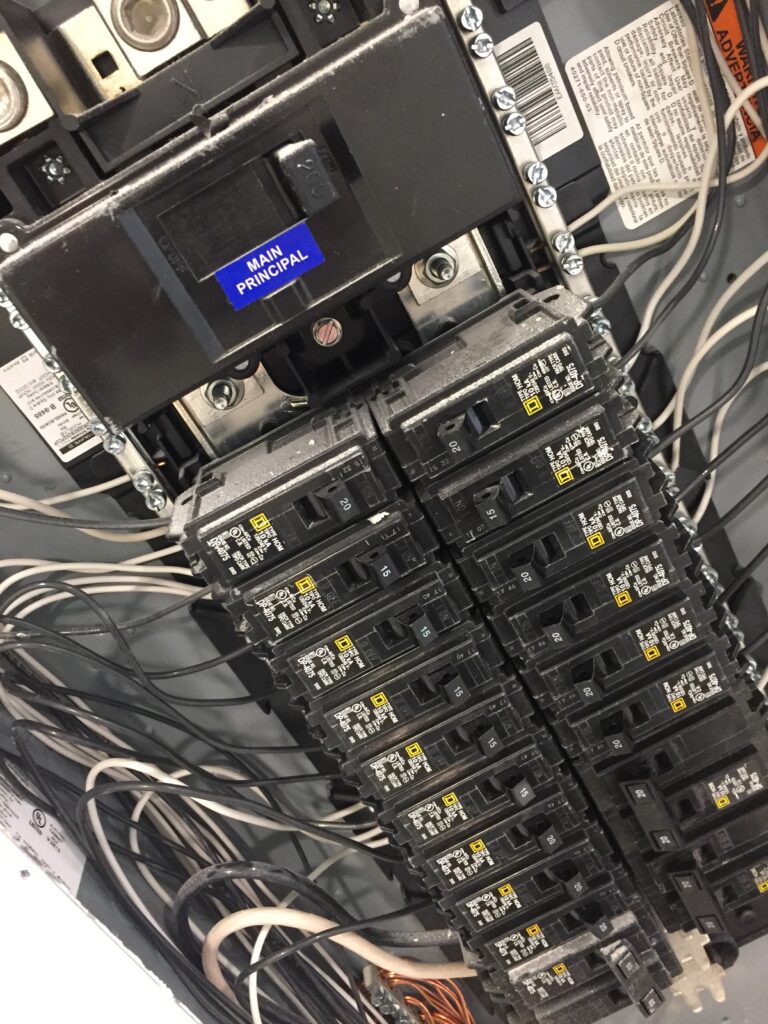
Start by leaving the circuit off and resisting the urge to reset it repeatedly, because a device that trips over and over is telling you a fault is still present. Repeated resetting forces current through the fault each time, which heats the damaged area, worsens the insulation breakdown, and can turn a leakage condition into an arcing one. Go to the panel and note precisely what you find, since a breaker in the tripped middle position, a GFCI breaker with its own test button popped, and a GFCI receptacle indoors or in the garage that feeds outdoor devices all mean different things. Write down which lights and which receptacles lost power together, because that grouping maps the circuit better than any label on the panel door. Check the panel cover for handwritten notes from previous work, and photograph the panel interior only if the cover is already off and the work is being done by a professional. If you see any moisture, rust, or staining inside the panel itself, stop entirely and call an electrician the same day.
Next, walk the property while everything is still off and look carefully at each fixture and enclosure that the circuit serves. Water sitting inside a lens, condensation fogging the glass, mineral staining running down a post, and rust at the base of a fixture stem are all strong indicators of intrusion. Check every outdoor receptacle cover to confirm it closes fully and that cords running through it are not holding the lid open. Look at mulch beds and lawn areas for fresh digging, settled trenches, mole tunnels, or spots where landscaping equipment recently worked. Inspect the caulk lines around wall mounted boxes and note any place where the bottom edge was sealed shut, since that traps water rather than releasing it. Photograph everything you find so the electrician arrives with a head start on the diagnosis.
Unplug and disconnect anything portable before any reset is attempted, including string lights, holiday decorations, pond pumps, fountain equipment, and plug in transformers. These items live outside continuously, their cords take physical abuse, and their internal seals are typically the weakest links on the entire circuit. With everything portable removed, a single reset attempt tells you a great deal, because a circuit that holds immediately points straight at one of the items you unplugged. If it trips again with nothing plugged in, the fault sits in the permanent wiring or in a fixture, and that narrows the search considerably. Do not attempt to open any weatherproof enclosure to look inside, since a box that has been holding water can discharge onto your hands and the conductors inside may be damaged in ways that are not visible from the outside. At that point the useful homeowner work is finished and the testing needs proper instruments. Tripping again right after a reset? Click here for our electrical repair service.
Isolating the Circuit When Outdoor Lighting Trips the Breaker After Heavy Rain
A professional isolation process begins by mapping the circuit completely, identifying every device fed by that breaker and the order in which they connect. Outdoor lighting circuits are frequently extended over the years by different hands, so the run that appears to serve four post lights may also feed a garage receptacle, a shed, or a soffit fixture on the far side of the house. Once the map is accurate, the electrician disconnects the circuit at a midpoint and tests each half separately, which cuts the search area in half with a single measurement. Insulation resistance testing then puts a number on the condition of the conductors, and a healthy run reads in the megohm range while a water damaged one reads dramatically lower. That measurement removes guesswork and prevents unnecessary replacement of components that are still perfectly good. It also documents the condition of the wiring in a way that supports an honest conversation about repair versus replacement.
Leakage current testing runs alongside insulation testing and is especially useful on circuits with many LED drivers. Clamping a meter around the hot and neutral conductors together measures the exact imbalance the GFCI is reacting to, and comparing that reading with fixtures energized in different combinations shows which ones contribute the most. On a circuit that has been retrofitted with LEDs, this test frequently reveals cumulative driver leakage as the true cause, and the solution becomes redistributing fixtures across separate circuits or replacing drivers with lower leakage models. On a circuit with genuine water intrusion, the leakage reading climbs sharply when the wet section is energized, pointing straight at the damaged area. Testing under real conditions matters here, since a system that has dried out for three days may test clean and give a false sense of resolution. Good electricians account for that by testing after rain when possible or by evaluating the physical condition of the enclosures.
The device itself always gets verified as part of a thorough diagnosis, because GFCIs and breakers do fail. GFCI protection contains electronics that degrade with age, surge exposure, and constant outdoor temperature swings, and a unit approaching the end of its life may trip on its own with no fault present anywhere. Testing with a proper GFCI tester confirms the device opens at the correct current level and within the correct time, and a device that fails that test needs replacement regardless of what else is found. Standard breakers can also weaken after years of thermal cycling and begin tripping below their rated load. Terminations at the breaker and the neutral bar get checked and torqued to specification, since a loose connection at the panel produces symptoms that mimic a fault out on the circuit. Verifying the protective equipment first prevents a scenario where good wiring gets replaced while the actual faulty device stays in service.
Repairs That Stop Outdoor Lighting From Tripping the Breaker After Heavy Rain
Lasting repairs share one trait, which is that they address how water is getting in rather than simply drying things out and reassembling them. Replacing a damp rated fixture with a wet rated one is often the single most effective change on an older property, and it costs far less than most homeowners expect. Fresh gaskets, new lenses, and stainless hardware keep the assembly sealed through the freeze and thaw cycles ahead. Every enclosure gets a drainage plan, meaning weep holes or listed drain fittings at low points in conduit and caulk applied only where it sheds water rather than where it traps it. Splices get remade with connectors listed for wet locations, and buried splices get proper direct burial kits instead of tape. Conduit gets reamed, bushed, and supported so the cable inside is not slowly sawing itself apart at every entry point.
Circuit design matters as much as the physical repairs, particularly on properties where lighting has been added a piece at a time. Splitting a heavily loaded lighting circuit into two or three separate circuits reduces cumulative leakage, improves reliability, and makes future troubleshooting far simpler. Dedicated circuits for landscape transformers, holiday receptacles, and permanent architectural lighting keep one failure from taking down the entire exterior of the house. Upgrading protection to devices designed for outdoor use and locating the reset point somewhere accessible saves aggravation every time something does trip. A panel with no room for additional circuits may signal that a service upgrade deserves consideration, especially on homes still running older 100 amp equipment with added loads like heat pumps, pools, and vehicle chargers. That conversation belongs in the same visit, since the panel is where every outdoor circuit begins.
Documentation and verification finish the job properly. After repairs, the circuit gets tested again with the same instruments used during diagnosis, and the readings should confirm healthy insulation resistance and leakage well below the trip threshold. Protective devices get tested to prove they open correctly, and every enclosure gets closed with the right gaskets and fasteners. A written record of what was found and what was corrected gives you something concrete to reference if symptoms ever return. Photographs of buried repairs, along with measurements from a fixed reference point, make future work on the property faster and cheaper. Work performed to current code standards also protects you at resale, when an inspector or a buyer’s electrician looks at the exterior wiring with fresh eyes.
Why You Need a Licensed Electrician for Outdoor Lighting That Trips the Breaker After Heavy Rain
Outdoor lighting faults sit at the intersection of water, electricity, and ground contact, which is the exact combination that makes electrical work dangerous. Someone standing barefoot on wet grass and touching a corroded post light is in the worst possible position, and that is precisely the situation these faults create. A tripping breaker is protection working correctly, but protection is a backup system and not a substitute for wiring that is actually intact. Every storm that soaks a damaged circuit spreads corrosion further and moves the system closer to a fault that generates heat rather than simply leaking. A licensed electrician brings the instruments to find the problem accurately and the code knowledge to correct it in a way that holds up. Getting it handled now costs less than getting it handled after the damage spreads through the whole run.
The Safety Risk of Ignoring Outdoor Lighting That Trips the Breaker After Heavy Rain
The most immediate danger is shock, and outdoor conditions remove nearly every protective factor that reduces risk indoors. Wet skin, saturated soil, and metal fixtures create a direct and low resistance path to ground through the body of anyone who makes contact. Children playing near landscape lights and pets digging in mulch beds are exposed to energized components in exactly the places where damaged low voltage wire tends to sit. A GFCI reduces that risk enormously, and that is precisely why bypassing or removing one after repeated trips is such a serious mistake. Leaving a known fault energized while relying entirely on the protective device to catch it is a gamble on equipment that also has a failure rate.
Fire risk builds more slowly but should not be dismissed. Corroded connections raise resistance, resistance produces heat, and heat concentrated at a single splice inside a plastic box can reach temperatures that char surrounding material. When that box sits against wood siding, inside a soffit, or near dry mulch, the ignition risk becomes real. Arcing faults produce localized temperatures far higher than any lamp ever will, and they can persist without drawing enough current to open a standard breaker. Repairing the connection properly removes the heat source entirely.
Damage also spreads outward through the electrical system when a fault is left alone. Water traveling inside a conduit does not stop at the fixture; it wicks along conductors and can eventually reach a junction box, a subpanel, or the main panel itself. Moisture inside a panel corrodes bus bars and breaker contacts, and that repair is dramatically more involved and more expensive than fixing a single wet box in the yard. Rust stains beneath breakers or on the panel interior are a serious finding that warrants same day attention. Catching the problem out in the yard keeps it out in the yard. Losing power to critical circuits during a storm? Click here for our emergency electrician service.

The Cost of Waiting on Outdoor Lighting That Trips the Breaker After Heavy Rain
Repair costs on outdoor lighting scale directly with how long a fault has been getting wet. A single flooded junction box caught early is a straightforward visit involving drying, new connectors, corrected drainage, and a fresh gasket. That same box left through an entire wet season corrodes the conductors feeding it, and now the repair extends back to the next accessible point in the run. Wait through a winter of freeze and thaw on top of that, and the conductors may need full replacement from the panel outward. The difference between those three outcomes is measured in months of delay, not in bad luck.
Property damage adds cost that has nothing to do with the wiring itself. Water entering a wall mounted box travels along the cable into the wall cavity, where it feeds mold growth and rots sheathing out of sight. Fixtures that fill repeatedly stain siding, brick, and stonework in ways that require refinishing rather than cleaning. Landscape lighting failures often mean digging through established beds, and restoring mature plantings and hardscape costs more than the electrical work. Fixing the water path early keeps the repair confined to electrical components.
There is also the practical cost of an exterior that does not work when you need it. Outdoor lighting handles safety on steps, walkways, and driveways, and dark exteriors lead to falls and discourage the visibility that deters trespassing. A circuit that fails every time it rains fails exactly when footing is worst and visibility is lowest. Homeowners who put off the repair through summer usually find themselves dealing with it in November, when the ground is cold, daylight is short, and the work is harder for everyone involved. Late August is an ideal window for this kind of repair, with warm soil, workable ground, and plenty of time before the holiday season.
Why Choose Edinson Electrical Solutions When Outdoor Lighting Trips the Breaker After Heavy Rain
Edinson Electrical Solutions is a family owned and operated local business based at 3049 Birch St in Hokendauqua, and we serve homeowners throughout Allentown, Bethlehem, Easton, Whitehall, Emmaus, Nazareth, Macungie, and the surrounding Lehigh Valley communities. We are licensed and insured in the Commonwealth of Pennsylvania, and every circuit we touch gets brought up to current code standards rather than patched to make the symptom disappear. Our electricians diagnose outdoor faults with proper test instruments, so you get an answer based on measurements instead of a guess that leads to unnecessary work. We explain what we found in plain terms, show you the evidence, and lay out the options honestly before anything gets replaced. Neighbors who have lived through the same storms tell us that straightforward approach is the reason they call us back.
Our work is built for long term reliability, which matters enormously on outdoor systems that face rain, snow, ultraviolet exposure, and temperature swings every year. We use fixtures and enclosures rated for the exact locations they occupy, connectors listed for wet conditions, and burial depths that meet code so cable stays protected from shovels and frost. Every job we complete carries our lifetime craftsmanship warranty, because we stand behind the quality of the installation itself. Financing is available through Synchrony for larger projects like circuit replacements, panel work, and full landscape lighting systems. We aim for a five star experience on every visit, from the first phone call through the final walkthrough.
Reaching us is simple, and we would rather hear from you before a small trip becomes a large repair. Call our office at (484) 898-7788 or send a message to info@edinsonelectrical.com to schedule a visit, and let us know when the tripping happens so we can plan the diagnosis around real conditions. We handle outdoor lighting repairs, new landscape and architectural lighting installations, GFCI protection upgrades, circuit breaker work, and full electrical inspections for homes across the Lehigh Valley. Our team shows up on time, protects your property while we work, and leaves the site clean. Your outdoor lighting should turn on the same way after a storm as it does on a clear night, and we will make sure it does.