
How to Tell if Your Outlets Are Wired Safely for Holiday Decorations
Holiday decorating season arrives faster than most homeowners expect, and the outlets that carry the entire load are usually the last thing anyone thinks about until something stops working. Late summer and early fall are the ideal window to check that wiring, because you still have time to correct problems before the first strand of lights goes up. An outlet that looks perfectly normal on the wall can still be reverse wired, missing a ground, protected by nothing, or connected to a circuit that already runs close to its limit on a quiet evening. Add a few hundred watts of decorations, an inflatable motor, and an extension cord run across a wet lawn, and a marginal outlet becomes a real hazard. Homes across Whitehall, Allentown, Bethlehem, and the rest of the Lehigh Valley include a lot of older wiring that predates modern GFCI requirements, so the risk is not theoretical. The good news is that most of the warning signs are easy to spot once you know what you are looking for, and the fixes are straightforward when a licensed electrician handles them. This guide walks through how to tell if your outlets are wired safely for holiday decorations, what the code actually requires for indoor and outdoor receptacles, and when it makes sense to bring in a professional before the season starts.
Signs Your Outlets Are Not Wired Safely for Holiday Decorations
Most unsafe outlets give warning long before they fail, though the signals are quiet enough that busy households tend to ignore them. Discoloration around the slots, a plug that falls out under its own weight, a faint buzzing sound, or a faceplate that feels warm are all evidence of a connection that is no longer doing its job. Wiring problems hiding behind the wall are harder to catch by feel, which is why a simple tester is worth the few dollars it costs. Older receptacles in Lehigh Valley homes were often installed before tamper resistant and weather resistant requirements existed, and decades of use loosen the internal contacts that hold a plug firmly. Holiday decorations make these weaknesses obvious because they run for hours at a time, night after night, rather than for the few minutes a vacuum or a phone charger draws power. A receptacle that handles light duty without complaint can overheat under a sustained load. Checking each outlet you plan to use, before the decorations come out of storage, takes very little time and prevents the majority of seasonal electrical problems.
How to Test Outlets for Safe Holiday Decoration Wiring
The fastest way to check basic wiring is with an inexpensive three light receptacle tester, available at any hardware store in the region. You plug it into the outlet, and the pattern of illuminated lights tells you if the hot and neutral are reversed, if the equipment grounding conductor is missing, or if the neutral is open. Correct wiring shows a specific pattern printed right on the tester body, so there is no guesswork involved. Reverse polarity is the most common finding in older homes, and it means the switched side of a lamp or a decoration remains energized even when the device is turned off. An open ground means there is no safe path for fault current, which matters a great deal when you are running metal light stakes into damp soil or hanging illuminated decorations from a gutter. Test every receptacle you plan to use for decorations, including the ones in the garage, the basement, and along the exterior walls. Write down which ones fail so you can hand the list to an electrician rather than trying to remember later.
It is worth understanding what a three light tester cannot tell you, because homeowners often assume a passing result means the outlet is perfect. These testers cannot detect a bootleg ground, which is a shortcut where someone jumped the neutral to the ground screw to make the tester read correctly on an ungrounded circuit. They also cannot measure the quality of the connection, so an outlet with loose backstabbed wires and heat damage inside can still show three correct lights. Voltage drop under load is another blind spot, and that is exactly the condition that causes dimming lights and overheating terminals during heavy holiday use. A tester also says nothing about the condition of the breaker feeding the circuit or about how much other equipment shares that same circuit. For those questions you need meters, a load calculation, and someone who can open the device and look at the terminations. Treat the tester as a first pass screening tool rather than a final verdict on safety.
Testing your GFCI devices is a separate and equally important step in this process. Press the test button on the GFCI receptacle, confirm that the reset button pops out and power is cut, then press reset and confirm power returns. A GFCI that does not trip when tested has failed and needs replacement, no matter how new it looks or how well it appeared to work last season. Devices manufactured after 2015 include an internal self test function that checks the sensing circuitry automatically, and many will refuse to reset or will indicate a fault when the internal components degrade. Older GFCIs from the 1990s and early 2000s have no such protection and can sit dead on the wall for years while everyone assumes they are working. Manufacturers recommend testing monthly, and the start of decorating season is a natural reminder to do it. Any GFCI that will not reset, trips with nothing plugged in, or feels warm to the touch should be replaced before you connect anything to it.
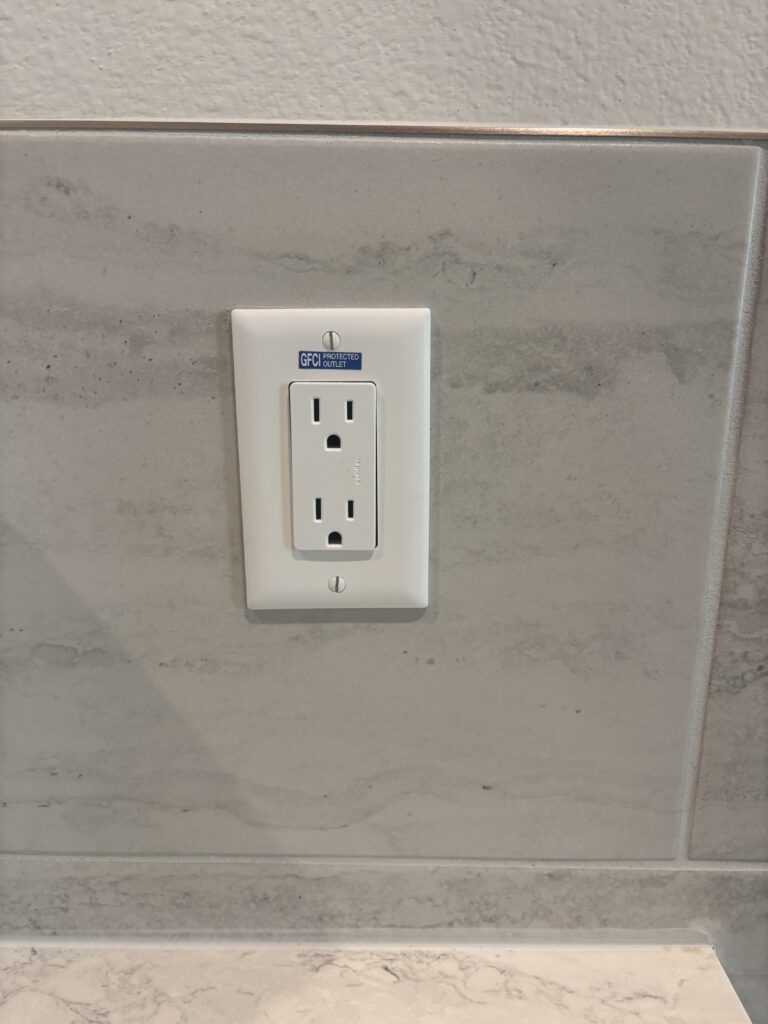
Warning Signs of Unsafe Outlet Wiring During Holiday Decorating
Heat is the clearest indicator that an outlet is not wired safely for holiday decorations, and it deserves immediate attention rather than a wait and see approach. Place the back of your hand near the faceplate after decorations have been running for an hour and note any noticeable warmth. Loose terminal screws, worn contacts, and backstabbed connections all increase resistance, and resistance turns electrical energy into heat right at the connection point. That heat degrades the insulation on the conductors, which increases resistance further, creating a cycle that ends in scorched plastic or a fire inside the wall cavity. Brown or black staining around the slots is proof that arcing has already occurred at that location. A burning smell, even a faint one that comes and goes, means you should unplug everything and stop using the outlet entirely. These conditions do not repair themselves and they get worse under the sustained load that holiday decorations create.
Plug retention tells you a great deal about the internal condition of a receptacle. When a plug slides in with almost no resistance or droops out of the wall under the weight of a cord, the brass contacts inside have lost their tension. Those weak contacts touch the plug blades across a smaller surface area, which concentrates current and generates heat exactly where you cannot see it. Holiday light plugs are often lightweight and get bumped constantly by wind, pets, and foot traffic, so a loose receptacle allows intermittent contact and arcing. You may notice lights that flicker when someone walks past or a section that goes dark and comes back on its own. Homeowners frequently blame the light strand for this behavior when the receptacle is the actual problem. Any outlet that will not hold a plug firmly should be replaced, and replacement is inexpensive compared to the damage a failing receptacle can cause.
Circuit behavior gives you another set of clues worth paying attention to during decorating season. A breaker that trips as soon as you add decorations is telling you the circuit is overloaded, and repeatedly resetting it without reducing the load is a mistake. Lights that dim noticeably when the furnace blower or refrigerator starts point to voltage drop from an overloaded or undersized circuit. A GFCI that trips every time it rains is doing its job and is warning you about moisture reaching a connection somewhere in the run. Buzzing or crackling from the receptacle, the switch, or the panel is never normal and should stop all decorating until it is investigated. If a specific outlet trips its breaker while others on the same circuit behave normally, the fault is likely local to that device or its wiring. Document what happens and when, because that history helps an electrician diagnose the problem quickly instead of chasing it.
Why Two Prong Outlets Are Not Wired Safely for Holiday Decorations
Plenty of homes throughout Bath, Nazareth, Hellertown, and the surrounding boroughs still have two prong receptacles on original circuits, and those outlets present a specific problem for decorations. A two prong receptacle has no equipment grounding conductor, which means there is no low resistance path back to the panel if a hot conductor contacts a metal enclosure or fixture housing. Without that path, a fault energizes whatever metal it touches and waits for a person to complete the circuit. Many holiday decorations include metal stakes, metal frames, or metal fixture bodies that people handle regularly while adjusting displays. Adapters that convert a three prong plug to fit a two prong outlet do nothing to create a ground and simply defeat the protection built into the cord. Homeowners often use those adapters without realizing they have removed a safety feature rather than accommodating one. The absence of a ground also means surge protective devices plugged into that outlet cannot function as designed.
The National Electrical Code does provide a legitimate path for improving these outlets without rewiring the entire house. Section 406.4(D)(2) permits replacing an ungrounded two prong receptacle with a GFCI device, which must then be labeled to indicate there is no equipment ground. The GFCI monitors the difference between current flowing out on the hot and returning on the neutral, and it opens the circuit when that difference reaches roughly four to six milliamperes. That protects people from shock even without a grounding conductor present, which is why the code allows it. It does not, however, restore the ground reference that surge protection and some sensitive electronics require. Any downstream receptacles fed from that GFCI can also be replaced with three prong devices, provided they carry the same labeling. This is a practical and code compliant upgrade, but it needs to be done correctly with the proper labels applied.
The better long term answer for many older Lehigh Valley homes is running new grounded circuits to the areas that carry the heaviest seasonal load. Dedicated circuits for exterior receptacles, garage outlets, and front porch decorations eliminate the guesswork about capacity and provide proper grounding throughout. An electrician can often route new cable through an unfinished basement or attic with minimal disruption to finished walls. If your panel is a older fuse box or a small service, that conversation naturally expands into service capacity, since adding circuits requires available space and adequate amperage. Homes with knob and tube wiring or early aluminum branch circuits from the late 1960s and early 1970s need particular attention, because those systems have known failure modes at terminations. A qualified electrician can identify what you have and recommend a realistic plan. Need grounded, code compliant outlets installed before decorating season? Click here for our GFCI outlet installation service.
How Outdoor Outlets Should Be Wired for Holiday Decorations
Exterior receptacles carry the highest risk during the holidays because they combine electricity, weather, and constant human contact in the same place. The code requirements for these outlets are specific, and they exist because outdoor decorating accidents follow predictable patterns. Every outdoor receptacle in a dwelling requires GFCI protection under NEC 210.8(A), and that requirement covers the outlets you will plug your lights into. Receptacles in damp or wet locations must be listed as weather resistant, and those in wet locations need a cover that keeps water out while a cord is plugged in. Beyond the device itself, the circuit behind it has to have enough capacity for the load you intend to put on it. Most homes have only one or two exterior receptacles, and homeowners routinely daisy chain far more decorations off them than the circuit can support. Understanding the requirements helps you plan a display that runs reliably from November through January without tripping breakers or creating hazards.
GFCI Protection Makes Outdoor Outlets Safe for Holiday Decorations
Ground fault circuit interrupter protection is the single most important safety feature for any outlet powering outdoor decorations. The device continuously compares current leaving on the ungrounded conductor to current returning on the grounded conductor, and any imbalance means current is finding another path. That other path is often water, wet soil, a damaged cord jacket, or a person standing on damp ground. When the imbalance reaches four to six milliamperes, the GFCI opens the circuit in a fraction of a second, well before the current level required to stop a heart. This protection works entirely independently of the equipment grounding conductor, which is what makes it so valuable outdoors where conditions change constantly. Rain, snowmelt, and freeze thaw cycles in Pennsylvania create exactly the conditions that produce ground faults. Every receptacle powering a decoration outside should be GFCI protected without exception.
Protection can be provided at the receptacle itself or upstream at the breaker, and both approaches are code compliant. A GFCI receptacle protects itself and any standard receptacles wired to its load terminals, which is a common and economical arrangement. A GFCI breaker in the panel protects the entire circuit including the cable run, which some homeowners prefer for exterior circuits that pass through crawl spaces or exterior walls. The practical difference matters during decorating season, because a GFCI breaker requires a trip to the panel to reset while a receptacle can be reset at the wall. If your exterior outlet is protected by a GFCI in the garage or basement, know where that device is before you need it at nine o’clock on a cold night. Label the protected receptacles so future occupants understand the arrangement. An electrician can map the protection scheme quickly and mark it for you.
Nuisance tripping deserves an honest explanation because it frustrates homeowners and tempts them into bad decisions. A GFCI that trips repeatedly with decorations connected is usually detecting real leakage current, not malfunctioning. Cheap light strings, damaged insulation, cracked lamp holders, water inside a connection point, and long cord runs with minor leakage all add up until the cumulative current reaches the trip threshold. Each individual string may leak an amount far below the threshold, but ten strings on the same circuit combine into a measurable fault. The correct response is to divide the decorations across more circuits, replace suspect strings, and dry out or elevate connection points. Bypassing the GFCI, replacing it with a standard receptacle, or using an adapter to defeat it removes the protection that keeps people alive. If a GFCI trips consistently and the load is reasonable, have the circuit evaluated rather than working around the symptom.

Weather Resistant Covers Keep Outdoor Outlets Safe for Holiday Decorations
The cover on an outdoor receptacle is not a decorative detail; it is a code required component with a defined function. NEC 406.9(B) requires that receptacles in wet locations have an enclosure that remains weatherproof while a plug is inserted, which is the bubble style or in use cover you see on newer homes. The older flip lid covers only seal when nothing is plugged in, which makes them useless for a decoration cord that stays connected for two months. Wind driven rain, sleet, and melting snow all find their way into an unsealed receptacle, and water inside the box corrodes terminals and creates the leakage current that trips GFCI devices. In use covers are inexpensive, install in minutes, and are sized to accommodate the bulky plugs and timers that decorations use. If your exterior receptacles have flip lids, upgrading them is one of the highest value improvements you can make before the season. Check that the gasket seals cleanly against the siding and that the cover closes fully with the cord routed through the designated opening.
The receptacle itself must also be listed as weather resistant, indicated by a WR marking on the device face. These devices use corrosion resistant contacts, plated mounting straps, and UV stabilized thermoplastic that holds up to sunlight and temperature extremes. A standard interior grade receptacle placed outdoors degrades quickly in Pennsylvania weather, and the failure shows up as intermittent connection, corrosion, and eventually arcing. Combine the WR receptacle with a tamper resistant rating, marked TR, and you have the device that current code requires for dwelling exterior locations. Replacing an old outdoor receptacle with the correct listed device is fast work for an electrician and permanently improves reliability. While the box is open, the electrician can verify that the cable entry is properly sealed and that the box itself is rated for damp or wet locations. Small details like a missing gasket or an unsealed knockout let water into the box just as effectively as a bad cover.
Mounting height and orientation influence how well an outdoor receptacle survives the winter. Boxes installed close to grade collect splashing water, road salt spray, and drifting snow, all of which accelerate corrosion and increase fault risk. Receptacles mounted under a soffit, on a covered porch, or at least eighteen inches above finished grade stay noticeably drier through the season. Cord connections should be elevated off the ground and kept out of standing water and snow piles, using a stake, a hook, or a purpose made cord protector. Never let a connection point sit in a puddle or under a downspout discharge, since that is where GFCI trips and corrosion problems concentrate. If your home lacks a conveniently located exterior receptacle, adding one in the right spot solves the annual extension cord problem permanently. Planning decoration outlets during a fall electrical project costs far less than improvising every December.
Circuit Load Limits That Keep Outlets Safe for Holiday Decorations
Understanding capacity is what separates a display that runs flawlessly from one that trips breakers every evening. A 15 amp, 120 volt circuit can deliver 1,800 watts at maximum, and the code limits continuous loads to 80 percent of that figure, which works out to 1,440 watts. A 20 amp circuit provides 2,400 watts maximum with a continuous limit of 1,920 watts. Holiday decorations qualify as continuous because they run for three hours or more at a time, so the 80 percent figure is the number to plan around. Remember that the circuit feeding your exterior receptacle almost certainly serves other outlets inside the house, and those loads count against the same total. Add up the wattage of everything on the circuit, not just the decorations, and leave real margin rather than calculating right to the limit. A load calculation done in October prevents a season of frustration.
The type of lights you choose changes the math dramatically. Incandescent C9 bulbs draw roughly seven to ten watts each, so a single 25 bulb strand can pull 175 to 250 watts on its own. Traditional mini incandescent strings run about 40 watts per 100 bulbs, which adds up quickly across a roofline. LED strings of the same length typically draw four to five watts per 100 bulbs, roughly a tenth of the incandescent figure. That difference means a circuit that supports five incandescent strands can often support forty or more LED strands, and manufacturers print the maximum end to end connection count right on the tag. Follow those printed limits rather than estimating, because the limit protects the conductors inside the string, not just the circuit. Inflatables, projectors, and animated figures include motors that draw a brief inrush current well above their running wattage, so give them their own circuit when possible.
Extension cords are the weak point in most residential displays and deserve the same attention as the outlets themselves. Use cords listed for outdoor use, identified by a W in the marking on the jacket, and match the gauge to the run length and load. A 16 AWG cord handles light loads over short distances, while runs beyond fifty feet or loads approaching ten amps call for 14 AWG or 12 AWG. Undersized cords heat up along their entire length and cause voltage drop that dims lights at the far end of a run. Never chain multiple extension cords together, never run a cord under a rug or through a doorway that pinches it, and never fasten a cord with metal staples that pierce the insulation. Inspect every cord for cracks, cuts, and damaged prongs before it comes out of storage, and discard anything questionable. Want a dedicated, properly sized circuit for your seasonal display? Click here for our outdoor lighting installation service.
Why You Need a Professional Outlet Inspection Before Holiday Decorations Go Up
A professional inspection catches the problems that no plug in tester and no visual check can reveal. Electricians open devices, examine terminations, measure voltage under load, verify circuit capacity, and confirm that protection schemes actually work as intended. That level of detail matters most in older homes, where original wiring, decades of modifications, and previous do it yourself work often coexist behind the same walls. Scheduling this work in late summer or early fall means any corrections are complete long before you want to hang lights. It also avoids the December rush when emergency calls dominate every electrician’s schedule in the Lehigh Valley. Edinson Electrical Solutions handles this work throughout Whitehall, Allentown, Bethlehem, Easton, and the surrounding communities.
What a Professional Outlet Inspection for Holiday Decorations Covers
A thorough outlet inspection begins at the service panel, where the electrician identifies circuit capacity, breaker condition, and available space for any additions. From there the work moves to individual receptacles, checking polarity, grounding, terminal condition, and device ratings against what the location requires. Devices are removed from their boxes so the electrician can see the actual connections, look for heat damage, and confirm that conductors are properly terminated under screws rather than pushed into backstab holes. GFCI and AFCI protection is tested with instruments that verify the actual trip current and response time rather than relying on the test button alone. Exterior receptacles get particular attention, including box ratings, cover type, gasket condition, and water intrusion evidence.
The inspection also includes a practical load assessment for the circuits you intend to use. The electrician maps which receptacles share each circuit, adds up existing connected loads, and calculates how much capacity remains for decorations. That information lets you plan a display around real numbers instead of guessing and hoping the breaker holds. If capacity is short, the recommendation might be a new dedicated circuit, a panel upgrade, or simply a different distribution of the decorations across existing circuits. Homeowners are often surprised to learn that the outdoor receptacle shares a circuit with a bathroom or a garage freezer. Knowing that relationship in advance prevents a nuisance trip that shuts down the freezer along with the lights.
You receive a clear written summary of what was found, what needs correction, and what is simply worth knowing. Items are prioritized, so genuine safety issues are separated from improvements that can wait until a future project. That documentation is useful beyond the holidays, particularly for insurance purposes, real estate transactions, and planning future electrical work. Many homeowners keep the report and work through recommendations over several seasons rather than all at once. Want a full evaluation of your home’s wiring before decorating season? Click here for our electrical inspection service.

When to Schedule an Outlet Inspection Before Holiday Decorations
Late August through October is the ideal window for this work, and there are practical reasons behind that timing. Scheduling is easier before the seasonal rush, parts are readily available, and outdoor work is far more pleasant in mild weather than in freezing rain. Any corrective work identified during the inspection can be completed on a normal schedule rather than as an emergency. If the findings point toward larger projects like a panel upgrade or new circuits, you have time to plan and budget without pressure. Waiting until Thanksgiving weekend to discover an outlet problem puts you at the back of a very long line.
Certain circumstances make an inspection more urgent regardless of the calendar. Homes built before 1975, homes that have changed hands recently, and homes with any history of breaker trips or flickering lights all warrant a closer look. Any receptacle showing discoloration, warmth, buzzing, or plug retention failure should be evaluated immediately rather than at seasonal convenience. If you have added significant electrical load in recent years, such as a hot tub, a workshop, or a vehicle charger, your capacity picture has changed. Recent finished basement or addition work by previous owners is another common source of hidden wiring problems.
Plan for the inspection to take a few hours in a typical home, longer in larger properties or those with complicated wiring histories. Clearing access to the panel, to basement and garage receptacles, and to exterior outlets speeds the process considerably. Have a rough idea of your decorating plan ready, including where displays will go and what they draw, so the load assessment reflects reality. The more specific you are about intended use, the more useful the recommendations will be. Small preparations on your end make the visit efficient and the results more actionable.
Why Choose Edinson Electrical Solutions for Outlet Wiring and Holiday Decoration Safety
Edinson Electrical Solutions is a family owned and operated local business serving the Lehigh Valley from our location at 3049 Birch St in Hokendauqua. We are licensed and insured in the State of Pennsylvania, and every job we perform is built to code for long term reliability rather than to the fastest possible finish. Our electricians know the housing stock in this region, from century old homes in Bethlehem and Easton to newer construction in Macungie and Coopersburg. That familiarity means we recognize the wiring patterns and common defects specific to each era of local building. We treat your home the way we would treat our own.
Every job we complete carries a Lifetime Craftsmanship Warranty, which reflects how seriously we take the quality of our terminations, our device selection, and our installation methods. We are dedicated to providing five star service on every call, and our reputation in the Lehigh Valley is built on repeat customers and neighbor referrals. Financing is available through Synchrony for larger projects like panel upgrades, new circuits, and whole home rewiring. That option lets homeowners address real safety issues on a workable schedule instead of postponing them indefinitely. We explain what we find in plain language and let you decide how to proceed.
Reaching us is simple, and we respond quickly during the busy fall and winter months. Call (484) 898-7788 or email info@edinsonelectrical.com to schedule an outlet inspection, a GFCI installation, or new exterior circuits before the decorations go up. Adding layered surge protection is another smart step for homes filled with LED controllers, timers, and sensitive electronics through the holidays. Protecting those circuits at the panel guards everything downstream from utility switching events and nearby lightning activity. Want to protect your entire home from damaging voltage spikes this season? Click here for our whole house surge protection service.